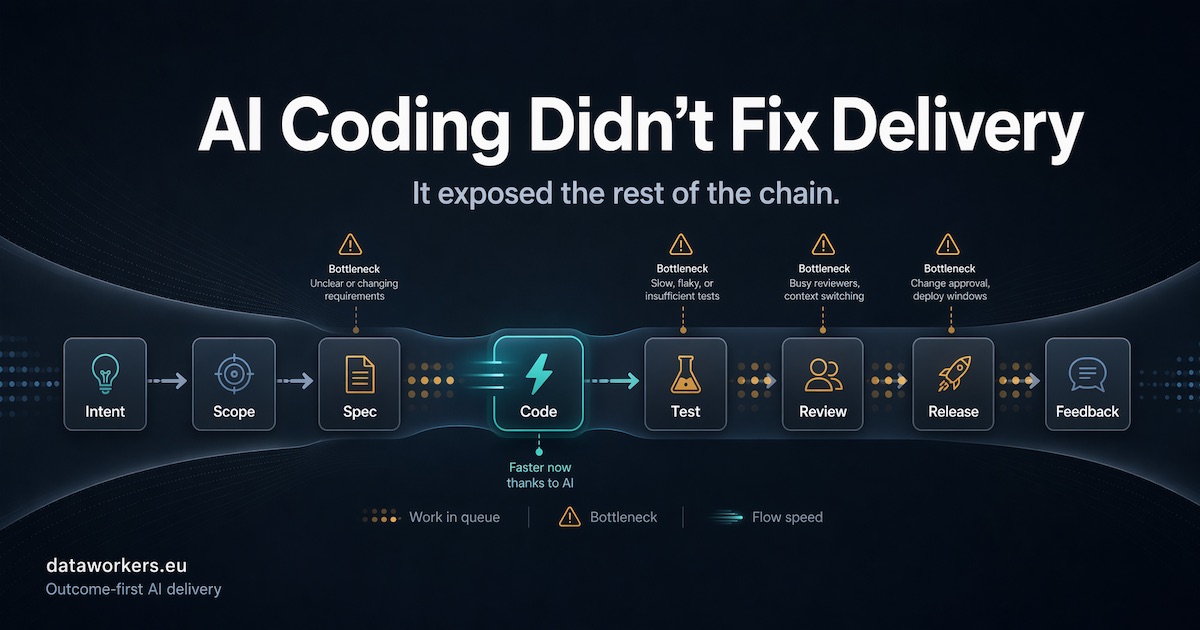
There is this interesting post from the OpenAI Codex team, Harness engineering: leveraging Codex in an agent-first world, and it makes one old truth much harder to dodge.
If you want coding speed to turn into production delivery speed, the rest of the delivery chain has to tighten up as well. Specs have to get clearer. Testing has to get faster. Approvals have to shrink or disappear. Release flow has to become safer and more automatic. Context has to be easier to find and easier to reuse. Otherwise faster coding just means you hit the next bottleneck sooner.
That was always true. It was just easier to ignore when writing code was still the most visible source of delay. Back then, "developers are slow" was a convenient story. Now that AI can draft code at absurd speed, that story is falling apart. The fragile parts of delivery are much easier to see because typing speed is no longer a credible explanation. I made a closely related argument earlier in Fast Code, Slow Delivery, but the OpenAI post makes the same point from a different angle: once coding gets cheap, the bottleneck does not disappear. It moves.
That is why the OpenAI article matters. Not because agents produced a lot of code, but because OpenAI had to engineer the surrounding system to let that speed mean anything.
The real lesson in the OpenAI post
The headline numbers are striking. OpenAI says the team built an internal beta with no manually written code, reached roughly a million lines of code, and did it in about one tenth of the time they estimate hand-writing would have taken. What makes that genuinely useful is that they did it in a few months while shipping to millions of users, which means the process had to be reliable, not just fast.
What matters is what they had to build around the model. The team made the repository more legible, turned docs into a real system of record, enforced structure with custom linters and tests, exposed UI state and observability to agents, and kept the feedback loop close to the work. That is the harness.
In plain language, they automated and encoded the rest of the delivery chain to the highest practical degree they could manage. They did not treat coding speed as the product. They treated coding speed as one fast component inside a controlled system.
That is the part many teams miss when they roll out AI coding tools. They speed up one stage, then act surprised when delivery does not move very much. But software was never just code drafting. It was always a chain: intent, scope, specification, implementation, validation, review, release, production feedback, and recovery. If the chain is fragile, faster code just makes the fragility more obvious. I pushed that broader point further in AI-Native Delivery Is a Team Sport, where the constraint shifts from individual developer throughput to the artifact chain across leadership, product, design, engineering, and QA.
AI made the old excuse harder to defend
I think this is the most useful management lesson in the whole story.
For years, it was easy to blame developers because their work was the most visible part of the process. You could point at the backlog, the sprint board, or a feature that had not shipped yet and tell yourself the problem must be inside engineering throughput.
The research does not really support that view. The SPACE framework argued that developer productivity cannot be reduced to one activity metric. DORA keeps making the same point in operational terms: lead time, deployment frequency, recovery time, change failure, and rework all describe the system, not just the coding step.
Look at where teams actually lose time. Atlassian reported that 69% of developers lose eight or more hours a week to inefficiencies. Cortex found that context gathering and waiting on approvals are among the biggest drains. Stripe's developer research pointed to maintenance and bad code eating a large part of the week. Those are not typing problems. They are flow problems.
That is why AI coding creates such a weird experience in many companies. Locally, it feels fast. Systemically, it often does not. More code shows up sooner, but the same old delays are still sitting there waiting: vague requirements, oversized changes, weak test scenarios, unstable priorities, environment friction, manual approvals, release anxiety. If those parts do not change, the extra coding speed does not translate cleanly into shipped value.
The harness is really the delivery system
This is also why I would translate "harness engineering" into a more ordinary phrase for most teams: delivery engineering.
The problem is not that companies need frontier-lab infrastructure. The problem is that most delivery systems were already too dependent on hidden context, manual interpretation, and human waiting time. AI did not create that weakness. It exposed it.
Once coding gets cheap, everything around coding becomes more important. A weak spec hurts more because wrong output arrives faster. Weak tests hurt more because more change volume arrives sooner. Slow approvals hurt more because queues build faster. Messy release discipline hurts more because the cost of validating and rolling back keeps growing. The same pattern shows up even before implementation starts: in Stop Overpromising: Use AI to Translate Proposals into Technical Reality, I wrote about how vague proposal language turns into ugly delivery because hidden complexity is still there whether or not the code gets drafted faster.
That is why I do not find the OpenAI story mainly inspirational. I find it clarifying. It shows that once a team is serious about AI-assisted delivery, the real work moves toward structure, constraints, validation, and feedback loops.
What ordinary teams should actually change
Most companies do not need six-hour autonomous agent runs. They do need better routines.
I would start with four boring things.
First, make every meaningful change easier to understand before implementation starts. A short context pack with user outcome, non-goals, acceptance examples, observable success signals, rollback path, and dependencies will do more for delivery speed than another round of generic AI adoption talk.
Second, force smaller batches. One of the easiest ways to waste AI is to let it generate huge changes that are miserable to review, hard to test, and risky to release. Small slices are still the best way to shorten feedback loops.
Third, push validation forward and keep it fast. If AI increases code volume, then test capacity becomes the bottleneck unless CI, preview environments, and release checks are built to absorb that volume. If you want some real control over generated code, aiming for 100% test coverage around the changed behavior is a reasonable place to start, especially in the core logic. A small concrete example of that delivery loop is in From formula to production in a few hours: what a tiny mortgage app taught me about AI-assisted delivery, where the useful unit of progress became prototype, pull request, preview, review, and deployment, not just generated code.
Fourth, attack queueing directly. Replace broad approval rituals with risk-based rules. Turn recurring ticket-based requests into self-service paths. Remove the places where work sits still waiting for someone to look at it.
The practical goal is not "AI-assisted coding" on its own. It is flow control across the whole delivery path: weekly constraint reviews, spec-by-example, preview environments, tighter release routines, and approval rules that reduce waiting without giving up control.
Closing
The strongest takeaway from OpenAI's post is not that agents can write a lot of code. It is that coding speed only matters when the rest of the system is designed to absorb it.
That was true before AI. AI just made it much more obvious.
If delivery is still slow after AI arrives, I would stop asking which coding model the team chose. I would ask which parts of the delivery chain are still manual, ambiguous, oversized, or queue-driven.
That is where the real limit usually is. And that is where the real work starts.
References
- OpenAI: Harness engineering: leveraging Codex in an agent-first world
- Microsoft Research: The SPACE of Developer Productivity: There's more to it than you think
- DORA: Software delivery performance metrics
- Google Cloud / DORA: The impact of generative AI in software development
- Atlassian: New research on developer experience highlights a major disconnect between developers and leaders
- Cortex: The 2024 State of Developer Productivity
- Stripe: The Developer Coefficient