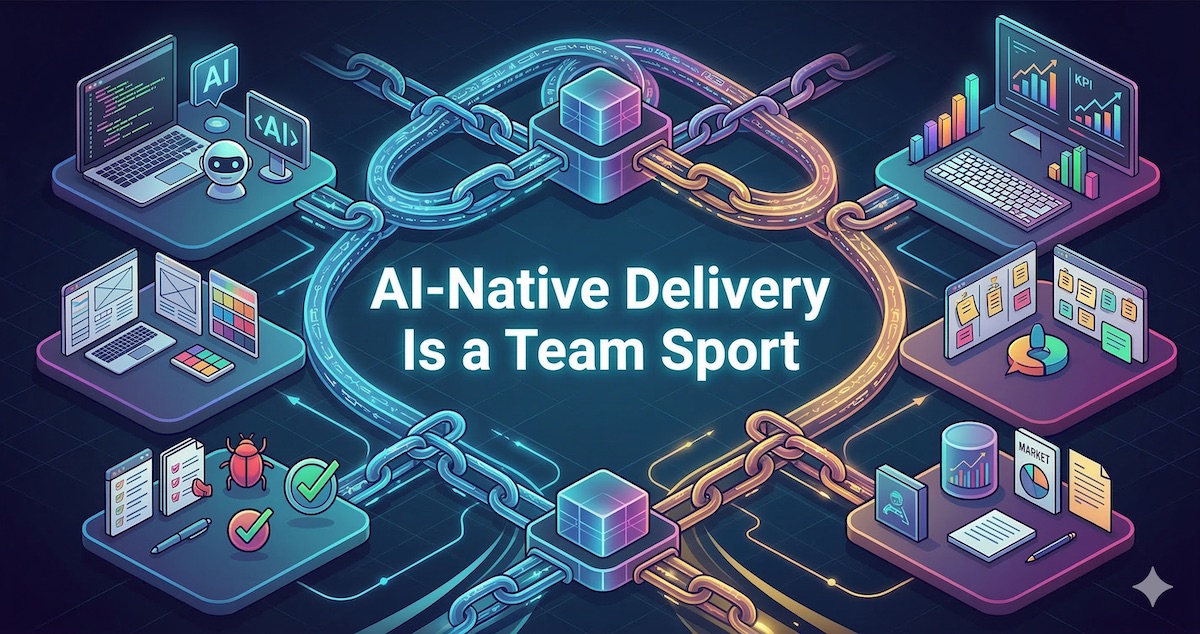
Most companies adopted AI in the most obvious place first: engineering. Give developers better tools, generate more code, and expect delivery to speed up. That move usually helps, but only up to a point. Once code gets cheaper, the next constraint is everything around it: vague intent, weak specs, late feedback, and the usual handoff losses between leadership, product, design, engineering, and QA.
That is why I keep coming back to the same conclusion: AI-native delivery is not "developers with assistants." It is a cross-functional operating model. If only one part of the team changes how it works, you get a faster local loop and the same old system-level drag.
The old bottleneck was never just typing speed
Traditional delivery is built around specialization and handoffs. Leadership decides what matters. Product turns that into scope. Design turns scope into screens and flows. Engineering turns that into implementation. QA tries to catch what was missed. Everyone then spends part of the week translating context back and forth because each artifact carries only part of the original intent.
That friction existed before AI, but slower implementation hid some of it. Now it is harder to ignore. A team can generate code, draft tickets, sketch flows, and scaffold tests much faster than before. If the underlying intent is still fuzzy, the team does not move faster in any meaningful sense. It just reaches confusion sooner.
Shared artifacts matter more than ever
The teams adapting well to AI usually tighten the chain of artifacts that sits between an idea and a release. I mean concrete things: a decision memo, a spec with explicit acceptance criteria, a prototype that tests the interaction instead of just the layout, a task breakdown that preserves the original intent, and a test pack that reflects the real risk surface.
This is not documentation theater. It is how you stop every function from solving a slightly different version of the same problem. AI makes first drafts cheap. That raises the value of reviewable, versioned context.
What changes by role
Leadership: exploration gets cheaper, so weak decisions get exposed sooner
Leadership should use AI to pressure-test direction before a team commits months of work. That can mean faster market scans, sharper assumption lists, clearer decision memos, or better framing around trade-offs and constraints. The value is not that AI "finds the answer." The value is that it becomes cheaper to inspect the shape of a decision before it hardens into roadmap debt.
Product and delivery: clarity becomes the main deliverable
PMs already spend a lot of time translating intent into something executable. AI can help draft tickets, but that is the least interesting part. The real leverage is in turning vague ambition into testable behavior, surfacing edge cases earlier, and writing acceptance criteria that survive contact with engineering and QA. In practice, the PM role becomes less about ticket throughput and more about owning clarity.
Design: prototypes move closer to the truth
AI-assisted design tools make it easier to explore directions early and throw away weak ones without losing a week. That changes the job. Design becomes less about polishing a handoff artifact and more about reducing uncertainty before implementation. A good prototype answers whether a flow works, where it breaks, and what needs to be true for engineering to build it cleanly.
Engineering: implementation speeds up, responsibility does not shrink
AI helps with scaffolding, repetitive changes, exploratory spikes, refactors, and test skeletons. That is useful, but it does not remove the core engineering job. Someone still owns architecture, data boundaries, failure modes, performance, security, and operability. If the upstream artifacts are weak, AI simply helps the team generate the wrong thing faster.
QA: quality moves earlier in the system
QA benefits when acceptance criteria are explicit enough to generate serious test matrices, not just a few happy-path checks. AI can help draft regression cases, bug reports, and automation scaffolds, but the bigger shift is structural. Quality stops being a late-stage filter and becomes part of how the work is shaped from the start.
Proposal work is part of delivery, not a separate universe
One place this becomes obvious is pre-sales and internal proposals. A lot of overpromising starts before engineering even sees the work. A feature sounds simple in business language, everyone nods, and only later does the real surface area show up: integration constraints, state transitions, permissions, rollout risk, support burden, and the long tail of QA.
AI is useful here because it makes technical interrogation cheaper before commitments are made. A proposal can be translated into components, dependencies, missing requirements, and likely failure modes while there is still time to narrow scope or timebox discovery. That is one of the cleanest uses of AI I have seen in practice because it reduces uncertainty at the point where bad assumptions are cheapest to fix.
I wrote that workflow up separately in Stop Overpromising: Use AI to Translate Proposals into Technical Reality.
How to pilot this without creating chaos
The mistake I would avoid is trying to "AI-enable" the entire delivery organization in one sweep. A smaller pilot is easier to learn from and much harder to politicize.
Pick one product slice. Define the artifact chain you expect to use end to end. Keep one person from each relevant function involved. Timebox the experiment. Then measure the things that actually matter: how many clarification loops happened, how long it took to reach a validated prototype, how much rework appeared later, and whether the team ended up with more confidence or just more output.
If the pilot reduces rework and shortens the path to a trustworthy decision, scale it. If it only increases visible activity, you do not have an AI adoption success story. You have a process problem with better tooling.
Closing
The real opportunity is not faster code in isolation. It is a delivery system that gets to clarity sooner, spots risk earlier, and wastes less energy translating intent between functions.
That is what I mean by AI-native delivery. The workflow changes for leadership, product, design, engineering, QA, and even proposal work. If only one of those functions adapts, the gains stay local. If the whole chain tightens, delivery actually gets better.