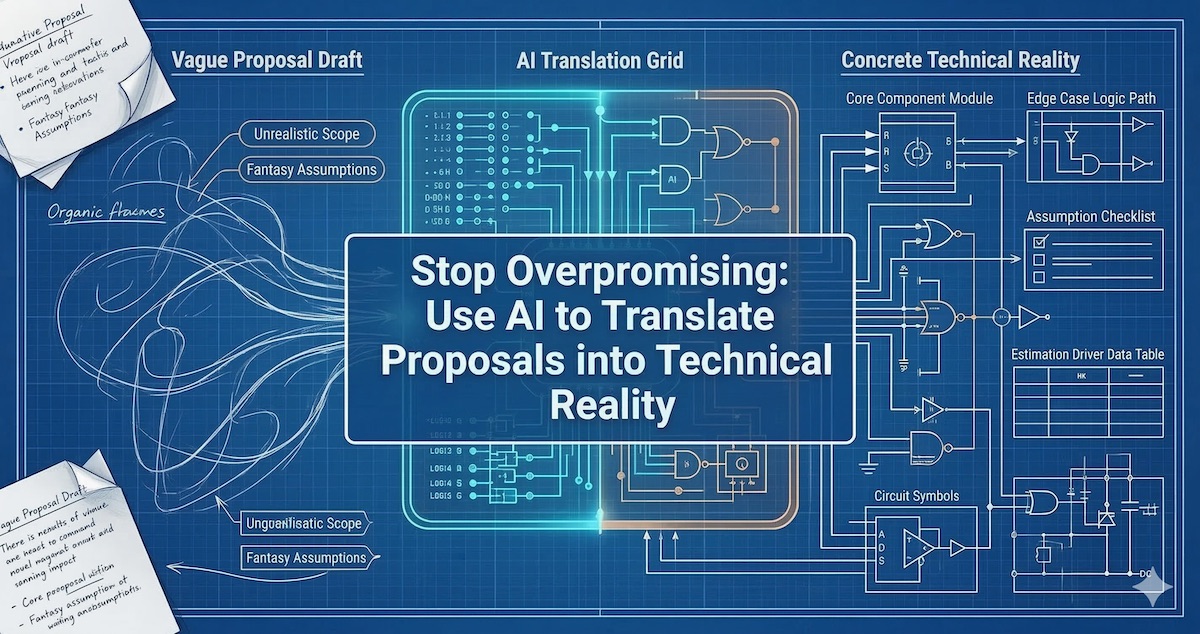
Overpromising usually does not start with bad intent. It starts with a proposal written in business language and read as if the implementation details will sort themselves out later.
That is how "simple on paper" work turns into ugly delivery. A line item that sounds harmless in a proposal can hide permission models, integrations, migration work, rollout constraints, operational support, and a QA surface area nobody priced in. Engineering then inherits the usual impossible job: make reality resemble the promise without blowing the timeline, the budget, or the product quality.
This is one of the most practical places to use AI. Not to replace engineering judgment, but to make technical interrogation cheap before commitments are locked in.
The problem is translation loss
Proposal language is optimized to explain value and scope at a business level. Delivery work happens inside systems, constraints, dependencies, and edge cases. That gap is where a lot of project pain begins.
Take a familiar line like "add Single-Sign-On." In a proposal it looks concise and reasonable. In delivery it can mean tenant boundaries, role mapping, SAML versus OIDC variance, provisioning, fallback auth, audit requirements, customer-specific configuration, and a support story for when identity breaks at 8 a.m. on a Monday. The proposal was not necessarily wrong. It was incomplete.
That incompleteness is what destroys estimates.
What AI is actually good at here
AI is useful when you ask it to turn business scope into a more technical map. It can help decompose a proposal into likely components, surface missing requirements, suggest clarifying questions, draft acceptance criteria, and propose phased delivery options. It can also rewrite proposal language so it stays confident without pretending uncertainty is gone.
What it cannot do is know your codebase, your operational constraints, or your customer commitments unless you give it that context. It also cannot sign off on architecture, security, or estimates. Human review remains the hard boundary.
Still, even with those limits, the upside is substantial. Teams can reduce uncertainty earlier and walk into a deal with fewer hidden traps.
A practical workflow
1. Lock the business outcome first
Before anyone talks implementation, define the result the work is supposed to create. That might be reducing onboarding time, cutting manual support load, or meeting a customer compliance requirement. If the outcome is vague, the scope will wander and the estimate will be fiction.
2. Translate the proposal into components
This is where AI earns its keep. Take the scope and break it down across frontend states, backend services, data changes, integrations, permissions, compliance constraints, QA impact, and operational changes. The goal is not precision theater. The goal is to expose where "simple" stops being simple.
3. Surface unknowns and hidden assumptions
Most estimate failures come from what was not said. Error handling expectations. Performance thresholds. Data ownership. Environments. Release constraints. Vendor dependencies. AI is good at generating the list of questions a senior engineer or architect would ask in week one. Ask them before the quote goes out.
4. Split the work into phases
When uncertainty is high, the honest move is not to guess harder. It is to structure the work so uncertainty gets retired deliberately. A timeboxed discovery phase, followed by an MVP, followed by hardening and rollout, is usually much more credible than a single block of scope with one confident number attached to it.
5. Write explicit boundaries into the proposal
A proposal should not just sound persuasive. It should be executable. That means clear in-scope deliverables, explicit out-of-scope items, assumptions, summarized acceptance criteria, and some form of change control. If those are missing, the team is not selling clarity. It is selling ambiguity with nicer formatting.
A checklist worth reusing
Every proposal should include:
- the business outcome or success definition
- in-scope deliverables
- out-of-scope items
- assumptions
- open questions
- dependencies such as access, vendors, and stakeholders
- key risks and mitigations
- a summary of acceptance criteria
- a phased plan from discovery to launch
- estimate ranges and the conditions that push the work toward the high or low end
If that list is still half empty, the team is not ready to commit confidently.
Prompts worth keeping around
Hidden complexity map
You are a senior software architect. Given the following proposal scope, list:
(1) hidden technical complexity, (2) key unknowns, (3) dependencies,
(4) non-functional requirements to clarify, and (5) risks that commonly blow estimates.
Organize the answer by Frontend, Backend, Data, Integrations, Security/Compliance, QA, and Deployment/Operations.
Scope: [PASTE]
Acceptance criteria and edge cases
Convert this scope into acceptance criteria and edge cases.
For each feature, include the happy path, failure modes, error handling expectations, and measurable "done" checks.
Scope: [PASTE]
Phased plan
Propose a delivery plan with phases: Discovery (timeboxed), MVP, Hardening, and Launch.
For each phase, list the objective, deliverables, and which unknowns get resolved.
Call out what cannot be estimated confidently before discovery.
Scope: [PASTE]
Proposal rewrite with boundaries
Rewrite this proposal so it stays confident but bounded.
Include assumptions, out-of-scope items, an acceptance criteria summary, and a short change-control note.
Avoid legalese. Keep it readable for an executive audience.
Text: [PASTE]
Estimate ranges and drivers
Provide an estimate as ranges rather than a single number.
Output best-case, likely, and worst-case ranges, plus the conditions that move the work between them.
Scope: [PASTE]
Why this matters
The point is not to make proposals longer. It is to stop delivery teams from inheriting fantasy scope. If AI helps a team ask better questions before work is sold, that is a very real gain. It protects margin, credibility, and delivery quality at the same time.
Most teams use AI after scope is already fixed. I think one of the better uses is earlier than that, when the work is still negotiable and the cost of being wrong is lower.
If you want the broader operating model around this, read AI-Native Delivery Is a Team Sport.