AI made one part of software dramatically cheaper: writing code. That matters because it changes how teams prototype, refactor, document, scaffold, and explore solutions. It lowers the cost of trying ideas. It speeds up implementation. It gives smaller teams capabilities that used to require much more headcount. At the same time it also creates a dangerous management illusion: if coding is faster, software delivery should automatically be faster too. In practice, that is often not what happens.
Many teams now produce more code, more pull requests, more branches, more technical activity, and still struggle to ship more finished, trustworthy product. Features look close, but are not really done. Releases move, but confidence does not. The visible pace increases while actual convergence slows down. That is not a contradiction. It is what happens when one part of the system accelerates and the rest stays the same.
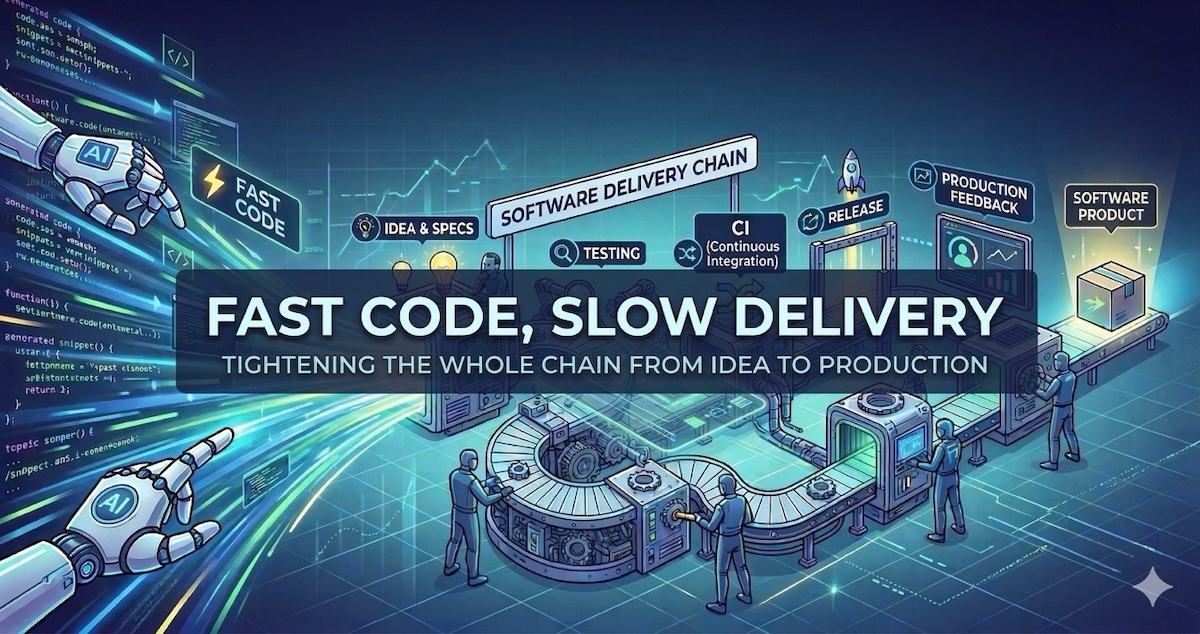
Software delivery was never just about coding. It is about turning an idea into a working result through a chain of decisions: problem framing, specifications, user stories, architecture, implementation, testing, CI, release discipline, production feedback, and iteration. AI speeds up one layer of that chain. It does not remove the need for the rest. In fact, it makes the rest more important.
The bottleneck did not disappear. It moved.
The limiting factor in software delivery is often not typing speed. It is ambiguity. Unclear goals. Vague specifications. Oversized tickets. Missing edge cases. Weak acceptance criteria. Fragile tests. Delayed integration. No real definition of done. No shared release discipline. No clear owner of the full path from idea to working behavior. AI amplifies all of that. If the input is fuzzy, AI can generate a large amount of plausible output very quickly. But plausible is not the same as correct. And activity is not the same as progress.
That is why some teams now feel fast and stuck at the same time. They are producing more software artifacts, but their system for turning those artifacts into validated production changes has not adapted. The first wave of AI adoption focused on coding speed. The next competitive advantage is delivery maturity.
“Done” has to become objective
One of the biggest weaknesses AI exposes is the informal definition of done. In slower environments, teams could sometimes hide behind effort. A feature took time, so people assumed progress was happening. AI reduces the cost of visible effort. That means the gap between “we worked on it” and “it is actually finished” becomes much more obvious. This is where many teams fail. They still treat done as a discussion instead of a contract.
A proper Definition of Done should be mechanical enough to verify. Not perfect, but explicit. A change is done when it works end to end, passes the relevant tests, clears CI, and can be demoed or released with confidence. Not when someone says it is “basically there.” That single shift changes behavior everywhere else. It forces smaller scope. It forces better acceptance criteria. It forces better testing. It forces earlier integration. It forces a team to stop reporting incomplete work as progress. In AI-assisted development, this is no longer optional. When code gets cheaper, proof becomes more valuable.
The delivery chain has to be redesigned end to end
If teams want to benefit from AI without drowning in rework, the whole operating model has to tighten up.
1. Start with sharper problem framing
If the initial problem statement is vague, AI will accelerate the wrong solution. Before work starts, the team should be able to answer a few basic questions clearly: what problem is being solved, for whom, what success looks like, what constraints matter, and what is explicitly out of scope. This is not process theater. It is the difference between fast execution and fast drift. A lot of delivery waste begins before the first line of code. AI simply exposes that faster.
2. Turn specs into something testable
Many teams say they have specifications when what they really have are intentions. A useful spec does not just describe what people hope will happen. It describes scenarios, examples, edge cases, failure conditions, and acceptance criteria clearly enough that someone else can verify the result without asking for hidden context. This matters even more when AI is involved, because AI will happily fill in the gaps. Sometimes it guesses correctly. Often it creates elegant-looking wrong answers. The fix is not more documentation for its own sake, but rather explicitness where ambiguity creates risk.
3. Write smaller, vertical user stories
One of the easiest ways to stay busy and ship slowly is to slice work horizontally - create separate tickets for frontend, backend, database, and testing. That creates motion, but not closure.
A better approach is vertical slicing: one small piece of user-visible behavior that crosses the full path from input to outcome. Small enough to finish in a day or two. Clear enough to demo. Narrow enough to test properly. This is how teams start finishing more work instead of accumulating more partially completed work. Small batches are not a style preference. They are how you shorten feedback loops and reduce rework.
4. Move testing forward
Faster code generation without faster validation is not acceleration. It is risk entering the system sooner. The highest-leverage teams treat testing as part of delivery, not as cleanup after implementation. That usually means many fast tests around business rules, a smaller set of end-to-end scenarios for confidence, and contract checks where systems integrate.
In modernization or rewrite work, characterization tests are especially useful. Instead of relying on memory or assumptions, they capture what the existing system actually does and create a safety net for change. The principle is simple: the faster the team can produce code, the more important it becomes to detect wrong behavior early.
5. Make CI a real gate
A weak CI pipeline is one of the fastest ways to waste AI-driven speed. If changes integrate late, problems pile up in expensive places. If the main branch is often unstable, the team is not moving fast. It is pushing instability downstream and creating delayed rework. Continuous integration only works when it is treated as a real constraint. Build, typecheck, tests, and core quality checks need to block bad changes. Feedback needs to come quickly. Fixing the broken build needs to outrank starting more work.
This is also where feature flags become useful. They let teams merge small increments and keep the main branch deployable even when functionality is not yet exposed to users. The goal is not theoretical elegance. The goal is a branch that stays shippable.
6. Treat production as part of the system, not the finish line
A lot of teams still act as if delivery ends at merge. It does not! Delivery ends when a change behaves correctly in production and the team learns from that reality. That means releases should be small enough to observe, safe enough to roll back, and instrumented enough to understand. Production feedback should shape the next slice of work. If that loop is missing, the team is still guessing, just with better tooling. AI does not remove that need. It increases it, because the volume of change can rise much faster than the quality of understanding.
Where management usually gets this wrong
The most common management mistake is treating AI as a productivity multiplier inside the old operating model. It is not enough to tell the team to use AI and expect the numbers to improve. If coding is suddenly faster, leadership has to redesign the system around that new speed. That changes the role of product, delivery, and technical leadership. The job is no longer just assigning work. The job is reducing ambiguity before work starts, making acceptance criteria explicit, protecting small batches, enforcing a real Definition of Done, and measuring validated outcomes instead of visible activity.
That is also why old metrics become less useful. Story points, hours worked, and pull request counts tell you very little in an AI-assisted workflow. More useful signals are lead time to a genuinely done change, defect return rate, change failure rate, test reliability, and how many small, usable slices reach production safely. Once code generation gets cheaper, management has to become more disciplined about proof, risk, and decision quality.
The common gotchas
There are a few traps that keep showing up.
The first is mistaking generated output for reduced uncertainty. AI can make the first version appear quickly. That says nothing about how quickly the team will reach a stable, trustworthy result.
The second is letting AI compensate for weak specifications. It can generate around the gaps, but it cannot remove the need for clear intent.
The third is keeping work too large. Big tickets hide ambiguity, delay testing, and make “done” negotiable.
The fourth is postponing validation until after the feature “mostly works.” That is how teams create fast output and slow trust.
The fifth is scaling headcount before fixing convergence. If the system cannot reliably turn work into done, adding more people often increases coordination faster than throughput.
The sixth is attempting major rewrites as one large move simply because AI makes rebuilding look cheaper. Faster code does not remove the risk of rediscovering years of hidden business behavior the hard way.
None of these are really tooling problems. They are operating model problems.
What good adaptation looks like
The teams that adapt well to AI usually converge on the same pattern.
They sharpen the problem before implementation. They make specifications concrete enough to verify. They write smaller vertical slices. They require executable proof before anything is called done. They integrate continuously. They keep the main branch releasable. They treat production feedback as part of product development, not as an afterthought.
None of that is glamorous. That is precisely why it matters. The real leverage is not in generating more code. It is in reducing uncertainty faster across the whole chain from idea to production.
Final thought
AI collapsed the distance between idea and code. It did not automatically collapse the distance between idea and trusted production change. That second distance is still where most of the business value lives. The companies that benefit most from AI will not be the ones producing the most code. They will be the ones that redesign the entire delivery system around speed without sacrificing clarity, validation, and control.
That is the shift that matters.