If you run an SME, the AI conversation can feel disconnected from daily work. One minute you hear that every competitor is automating everything, the next minute you hear warnings about legal exposure and data risk. Most owners I speak with are not anti-AI. They are trying to protect margin, keep operations moving, and avoid expensive mistakes.
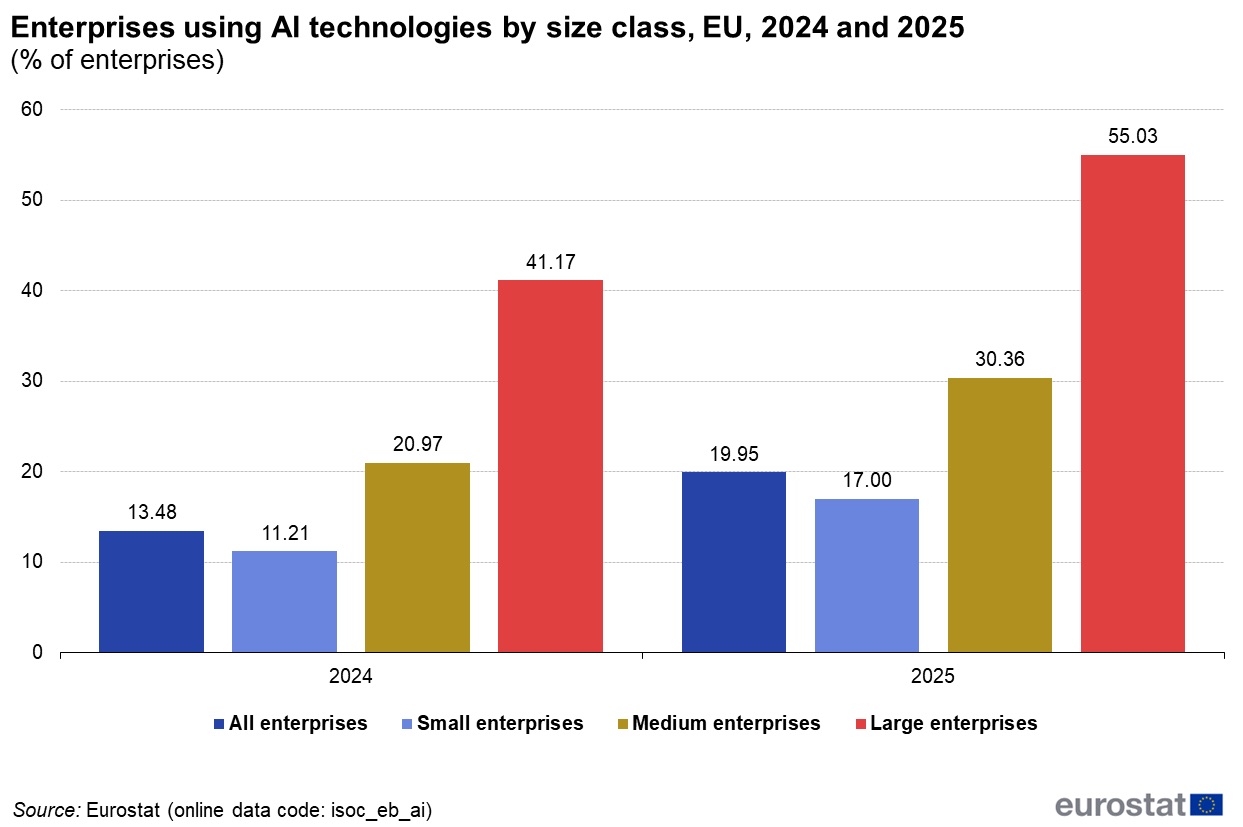
The latest Eurostat numbers tell a clearer story. AI adoption is rising, but not evenly. In 2025, 19.95% of EU enterprises used at least one AI technology, up from 13.48% in 2024. That sounds encouraging, until you look at company size: 17% for small enterprises, 30.36% for medium, and 55.03% for large. The gap is no longer theoretical. It is operational (see Figure 1) [1].
Large companies can afford dedicated teams, internal specialists, and longer experimentation cycles. Most SMEs cannot. In smaller firms, AI exploration is often squeezed into evenings by someone who already has five other responsibilities. I keep seeing the same pattern: high interest, low implementation capacity.
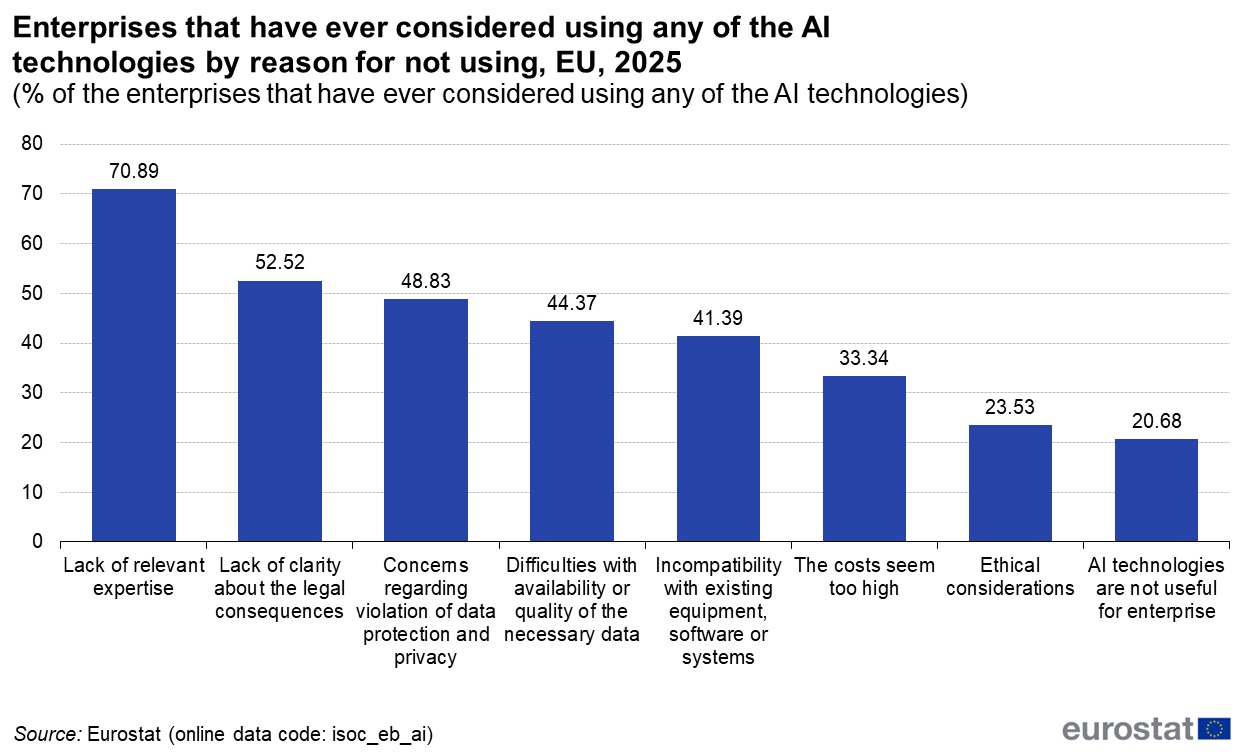
The same Eurostat dataset also shows why companies pause. Among enterprises that considered AI but did not adopt it, the top reasons were lack of relevant expertise (70.89%), unclear legal consequences (52.52%), and privacy/data protection concerns (48.83%) [1]. These are not excuses. They are normal risk decisions from people protecting both margin and reputation.
This is why "just train your team on AI" is usually the wrong first move for SMEs. The issue is not curiosity. The issue is choosing a safe starting point and shipping something useful before attention fades.
Why the SME AI gap keeps widening
The gap between large and small companies grows when AI is treated as a side hobby instead of an operational decision. Most SMEs are dealing with immediate pressures: late payments, regulation, admin burden, and hiring constraints. If AI does not clearly reduce one of those pains, it stays in the "nice to have" pile.
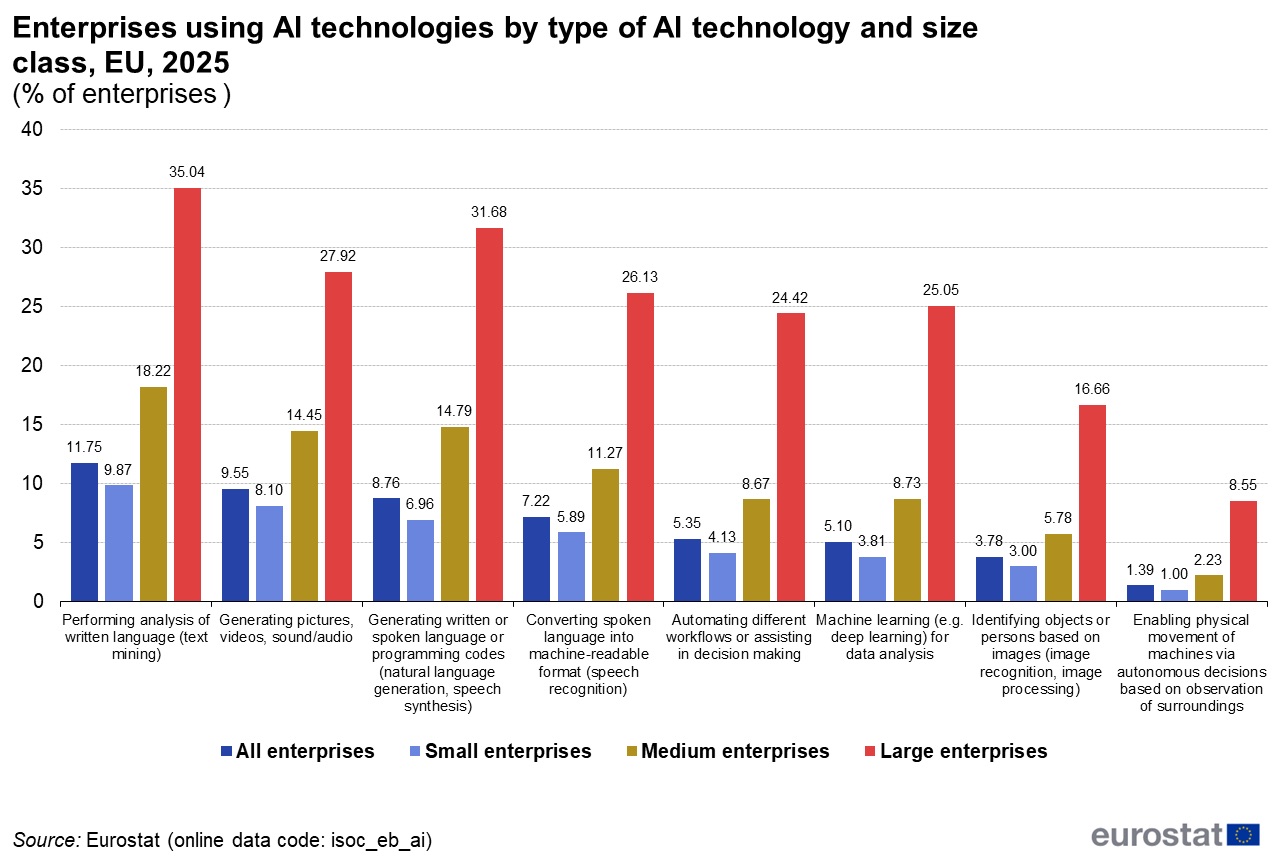
The adoption spread across AI technology types is also uneven by company size, which reinforces this execution gap (see Figure 2) [1].
That is also why fear-based messaging rarely works. "Adopt AI now or die" sounds dramatic, but leaders hear hype. A stronger argument is straightforward: take one low-risk workflow, improve it, measure the outcome, and decide from evidence.
The three fears are real, but manageable
The main non-adoption reasons are shown in Figure 3, and they confirm what we see in SME projects: this is mostly a capacity and risk problem, not a motivation problem [1].
1) "We do not have AI expertise"
This is the easiest barrier to fix. SMEs do not need an internal AI department to start. They need an external partner who can run a focused workflow audit with internal owners, pick one high-friction process, and implement a small pilot with measurable outcomes.
Practical demonstrations still matter. Once people see concrete examples of what current AI tooling can do in their context, they usually come up with better ideas for where it can help in their own workflows.
In practice, this works best as done-with-you delivery, not classroom training: one process, one owner, a clear baseline, a measurable KPI, and real production usage within weeks.
2) "Legal is unclear"
Legal uncertainty should slow reckless rollout, not block all rollout. A capable implementation partner reduces this risk by setting guardrails early: approved tools, data boundaries, mandatory human review points, and escalation rules for sensitive cases. Most SMEs already apply similar controls to other SaaS vendors. AI should be onboarded with the same discipline.
3) "What about privacy and data security?"
This concern is valid, but unmanaged usage is usually the bigger risk. In many companies, people are already experimenting informally with public tools. That is shadow AI. A lightweight policy, approved tooling list, and simple review rules reduce exposure more than pretending AI is not being used.
Stop treating AI as a marketing intern
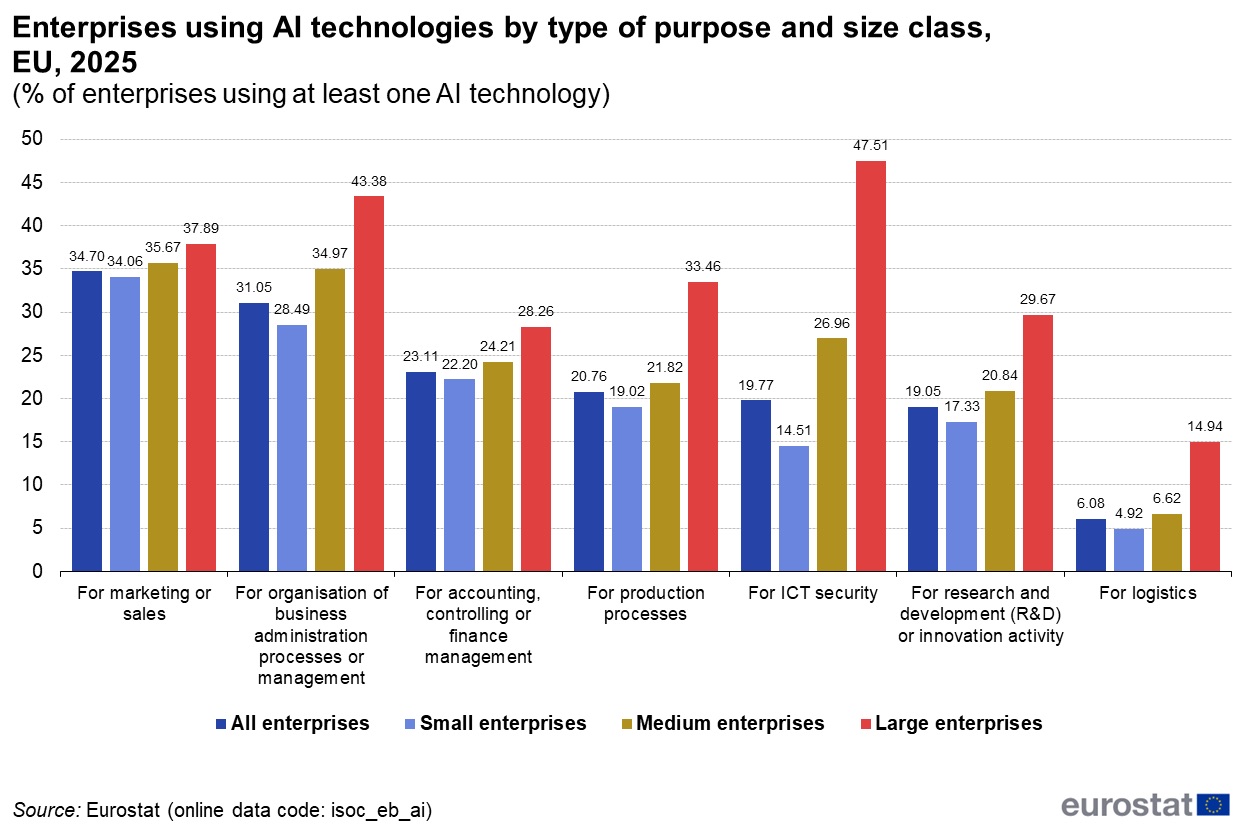
Marketing was often the first function to adopt AI, and that was a useful start. But if AI stays limited to content generation, value plateaus quickly. As I covered in AI Is a Multiplier. So Is Laziness, output tends to converge: similar posts, similar visuals, similar pages, similar tone.
Another common issue is that many leaders treat AI as a synonym for ChatGPT. That narrows decisions too early. The practical opportunity is much broader: workflow automation in finance and operations, triage and classification in support and inboxes, proposal and documentation pipelines, and management reporting built around real business processes.
Figure 4 shows where AI is currently used by purpose; this is exactly why SMEs should expand beyond content tasks and focus on operational workflows [1].
One underused use case for leadership teams is vendor oversight in software delivery. LLMs can now translate natural language into technical checks and, just as importantly, translate code and pull requests back into plain language. That makes it much easier for non-technical executives to review daily progress from a repository, confirm whether delivered work matches expectations, and spot risk signals like scope drift or technical debt before they become expensive.
The bigger opportunity for SMEs is therefore operational: cash collection, internal documentation, repetitive communication, admin-heavy processes, and clearer control over external delivery.
A better way to think about first use cases is simple: pick the tasks your team quietly hates doing every week, then implement one with an external partner and an internal owner. Receivables follow-up, proposal preparation, client status updates, and turning messy notes into clean SOPs are strong starting points because they are frequent, measurable, and low-risk to pilot.
A rollout model that fits SME reality
What works is not a fixed calendar. It is a controlled rollout sequence that reduces risk and builds confidence.
Start with one working session between leadership, process owners, and an implementation partner. Review practical tooling examples, map repetitive workflows, and choose one process that is frequent, painful, and safe to pilot.
Then move that process into production with a narrow scope and clear guardrails: approved tools, data boundaries, and mandatory human review where needed.
After rollout, measure against baseline: time saved, cycle time, rework/error rate, and real team adoption. If the result is clear, standardize and expand to the next workflow. If not, tighten scope and iterate.
This is how SMEs build AI capability without betting the company.
What matters now
AI adoption in Europe will continue to rise. The core question for SMEs is not whether to copy enterprise programs. It is whether they can learn faster than the adoption gap grows.
If you are leading a smaller company, do not begin with a broad "AI transformation." Begin with one process that is slow, repetitive, and expensive. Fix that. Measure it. Then scale what works.
That is how you move from AI anxiety to operational advantage.