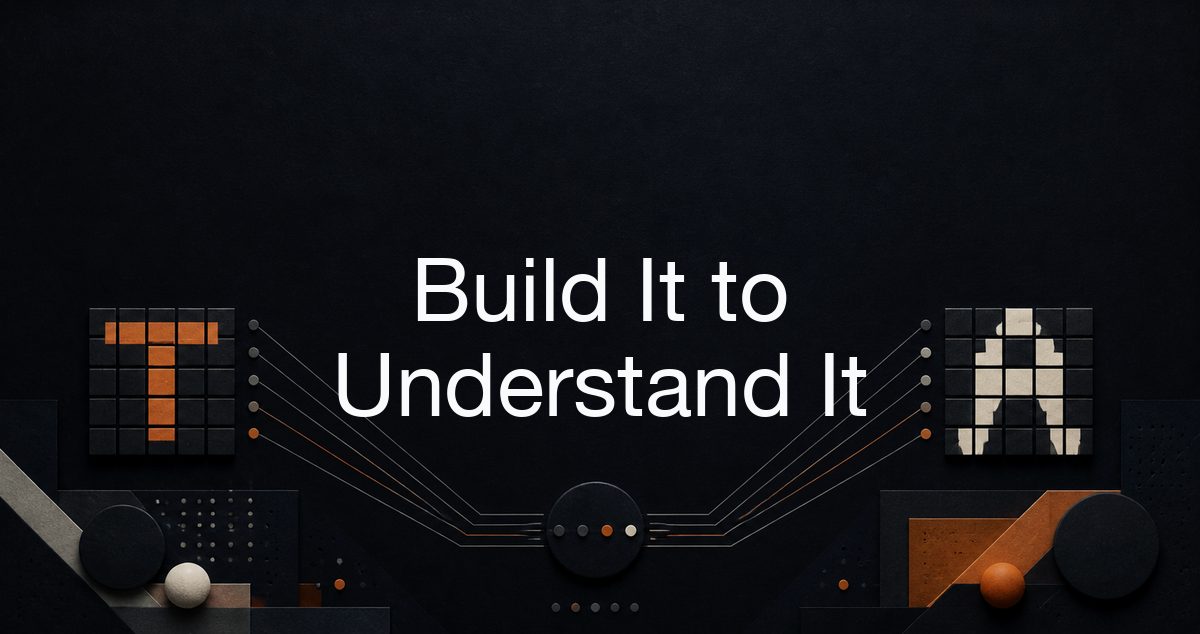
I kept coming across the word perceptron whenever I tried to understand where neural networks started. The explanation was always short: inputs come in, every input has a weight, the model adds everything together and picks an answer. When the answer is wrong, the weights change.
I could repeat that definition, but I still did not feel that I understood it. So I did what I increasingly do when an explanation stays too abstract: I asked AI to help me build something I could touch. It became a small browser app that learns to distinguish a blocky letter T from an A.
The perceptron itself is tiny. The letters live on a five-by-five grid, so the model gets 25 inputs. Each pixel has a learned vote, plus there is one extra value called the bias. Add the votes together, cross a threshold, and the model chooses T or A. That is basically the whole machine.
That small size is why I wanted it as a learning example. There is nowhere for the mechanism to hide behind a polished chat answer or a huge diagram.
Try it
Open the perceptron demo in a new tab
Start with "Step once." It is tempting to press Train immediately, but stepping through one example is where the idea becomes visible. You see the letter, the guess and the weight change after a wrong answer.
Then train it and start breaking things. Remove part of the T, add pixels to the A, or change the training examples. You can even create contradictory examples that one perceptron cannot solve. Once I started testing those limits, the formula stopped feeling like something I had memorized. I could finally reason about what the model was doing.
What this has to do with modern LLMs
The obvious question is how any of this relates to ChatGPT. I do not want to oversell the connection. ChatGPT is not a giant perceptron, and GPT-2 does not contain 1.5 billion little copies of this demo. Modern language models use transformers, attention, deep layers and a much more complicated training process.
The part that survives is simpler. Training changes numerical parameters, and those learned numbers change the output. My demo has 25 weights and one bias. GPT-2 XL has about 1.5 billion parameters spread across its whole architecture. The scale is completely different, but the basic idea that a model learns by adjusting internal numbers is still there.
The perceptron does not explain an LLM, but it gives me one small piece I can see whole before the diagrams turn into hundreds of boxes and arrows. The demo links to the GPT-2 paper and OpenAI's implementation for anyone who wants to check the architecture and numbers.
AI can build the lesson, not just explain it
This is the part I care about more than the perceptron itself. I could have asked ChatGPT for another explanation, nodded at the answer and forgotten most of it ten minutes later. Building the demo changed the interaction. I had to decide what should stay visible, what I wanted to change and which simplifications were still honest.
With ChatGPT Work and Codex, Claude Code, or a similar tool, the first version of something this small can take minutes. It does not need accounts, a database or a serious deployment project. One HTML file is enough to turn the idea into something I can open, test and share.
Of course, fast does not mean correct. AI can build a confident-looking mistake just as quickly as a useful teaching tool. I still had to check that the weight updates were visible, that impossible examples failed for the right reason and that the GPT-2 comparison did not pretend the two systems were equivalent. If I cannot review those decisions, then I have not really understood the subject yet.
The company use is bigger than this example
The same habit is useful outside machine learning. Every company has concepts that keep getting explained in documents and meetings, but the explanation never quite sticks. It might be a margin calculation, a blocked process, or the consequence of depending on one vendor. A small interactive model can make that cause and effect visible.
I am not suggesting that every training deck should become an app. That would be another silly AI solution looking for a problem. But when people repeatedly misunderstand the same rule, AI makes it cheap enough to try a small demo and see whether it helps. That is much closer to the kind of AI adoption I find credible than buying subscriptions or running another prompt workshop.
Some experiments should stay disposable. Once a demo starts using private data or influencing real decisions, it is software, and security, testing, maintenance and technical ownership come back into the picture. AI making the first version fast does not remove any of that.
The perceptron is simple. What changed for me was realizing that I no longer have to leave every difficult idea at the level of text. If I can define the question clearly enough, I can ask AI to help me turn it into something I can poke at until it finally makes sense.