I wanted to know whether a folder full of podcast transcripts and scientific papers could become something more useful than a searchable archive. The test was simple: build a local knowledge base, ask it for practical sleep and nutrition guidance, and see whether the result stayed faithful to the source material.
The result was better than I expected. I ended up with a maintained Obsidian wiki and two polished PDF presentations: a 17-page daily sleep guide and a 14-page daily nutrition guide. Both carry source identifiers, evidence limits and clear boundaries around what the underlying material does and does not support.
AI models can already make slides. What changed the result here was the source behind them: a durable, inspectable body of knowledge that had already been organized, cross-linked and checked for gaps.
You can see the finished outputs here:
These decks are an evidence-synthesis demonstration, not personalized medical advice. Their recommendations still need to be interpreted in the context of individual health, medication and clinical guidance.
The idea: stop rediscovering the same documents
The starting point was Andrej Karpathy's llm-wiki idea. His argument is that the usual document-chat pattern makes the model rediscover knowledge from raw files every time you ask a question. A maintained wiki gives the model a persistent intermediate artifact instead: summaries, concepts, entities, comparisons, contradictions and links that improve as more sources are added.
The architecture has three layers:
- Raw sources that the agent can read but should not rewrite.
- A Markdown wiki that the agent maintains.
- An operating schema that tells the agent how to ingest, cite, update and check the wiki.
Obsidian was a natural interface for this because the knowledge stays in ordinary local Markdown files. I can browse the pages, follow links, inspect the graph and use Git history without depending on a proprietary knowledge-base format.
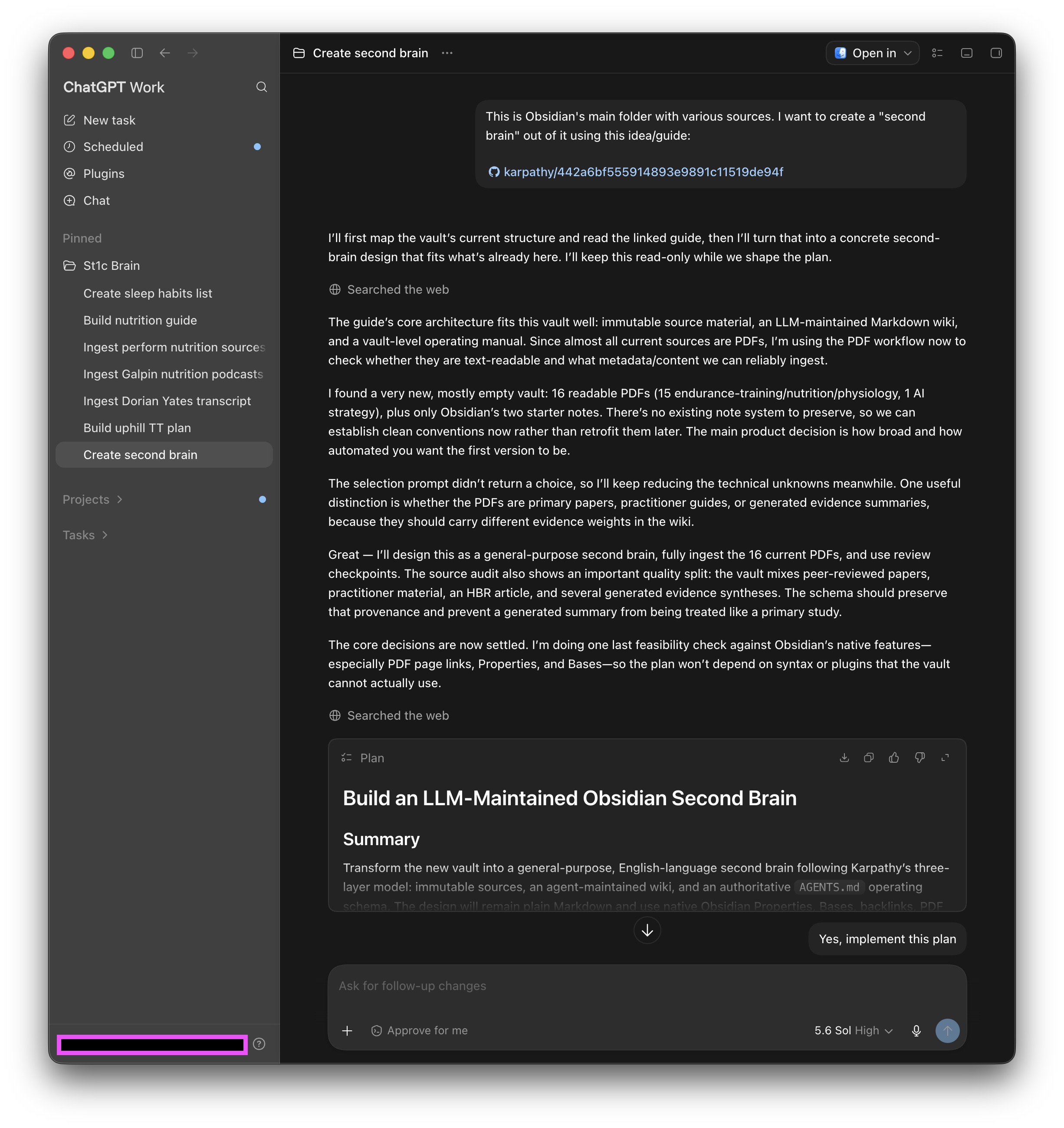
I shared Karpathy's gist with the ChatGPT desktop app in Codex mode and gave it one short prompt:
This is Obsidian's main folder with various sources. I want to create a "second brain" out of it using this idea/guide:
I ran the work with GPT-5.6 Sol on High reasoning, which OpenAI describes as extended reasoning for complex work.
Collecting the source material
I built the first two knowledge clusters around sleep and nutrition. The sleep material came from Andrew Huberman's sleep hygiene collection, including the series with Matthew Walker. The nutrition material came from the nine podcast pages grouped under Andy Galpin's Perform nutrition topic, along with the research papers referenced by those episodes.
For YouTube playlists, the only specialist command-line tool I needed was yt-dlp. This command downloads the English auto-generated subtitles without downloading the videos:
yt-dlp \
  --skip-download \
  --write-auto-subs \
  --sub-langs en-orig \
  --sub-format ttml \
  "https://youtube.com/playlist?list=PLPNW_gerXa4OoypUEgZI7uouI12WZrxeS&si=10XOe6kAiR_tsfFR"
The podcast pages also linked to papers used in the episodes. I asked the agent to collect the transcripts and locate accessible copies of the referenced research, including author manuscripts or preprints when publisher copies were unavailable. I kept the original papers inside the private vault; the public downloads on this page are my derived presentations, not a redistribution of the source library.
The source-collection prompt
Can you use available skills to explore these podcast's website from Andy Galpin about Nutrition Topic:
https://www.performpodcast.com/topics/nutrition/
There are 9 links to podcast. Each link when opened contains also a possibility to download PDF version of the transcript - or you can simple scrap the HTML content of the transcript directly to some MD file. Each podcast detail page also contains a section with "Articles" - which are scientific evidence papers used in given podcast - also try to download those PDFs. If not possible to use direct link, try to find an alternative way like searching via google for the title of the paper + PDF. Usually there is always an alternative download page (like author's edit version, or pre-print version) if you search with google for the title + pdf - many will point to "researchgate.com" or similar pages, or directly to the university page of the authors - were you can download the missing PDF. Put all of those things to Inbox for later further processing into the vault itself
Source collection still needs judgment. A search result is not automatically a legitimate or authoritative copy, and a generated transcript is not the same thing as a peer-reviewed paper. The vault therefore records provenance, source type, retrieval date, evidence role and missing primary references instead of flattening everything into one pile of text.
The operating manual mattered more than the folder tree
The agent created an AGENTS.md operating manual at the root of the vault. This became the most important file in the system. It tells any future agent which files are mutable, how source IDs work, how claims must be cited, how uncertainty is preserved and what needs to happen before an ingest is considered complete.
Authority boundaries
Inbox/is the vault's sole mutable intake.- Filed material elsewhere under
Sources/is immutable. Read it, hash it and link it; never edit it.Wiki/is agent-owned. The agent maintains synthesis while preserving citations, provenance and uncertainty.Evidence and citation rules
- Put a direct source link after every material factual claim.
- Separate what the source reports from the agent's inference.
- State important population, protocol, comparator and measurement limits near the claim they qualify.
This is where the experiment moved beyond "chat with my files." The agent was not merely asked to answer questions. It was responsible for maintaining a small knowledge system:
Inbox/held new, mutable intake.Sources/held filed source material that became immutable.Wiki/Source Notes/described individual sources.Wiki/Concepts/,Wiki/Topics/andWiki/Questions/held reusable synthesis.System/held the manifest, ingest log, templates and lint report.
The exact folder names can change, but the ownership boundaries need to remain explicit. Without them, an agent can silently rewrite a source, create near-duplicate concepts, lose the connection between a recommendation and its evidence, or treat a polished summary as if it were primary research.
Processing the nutrition inbox
Once the source collection was ready, I asked the agent to process the nutrition cluster into the vault:
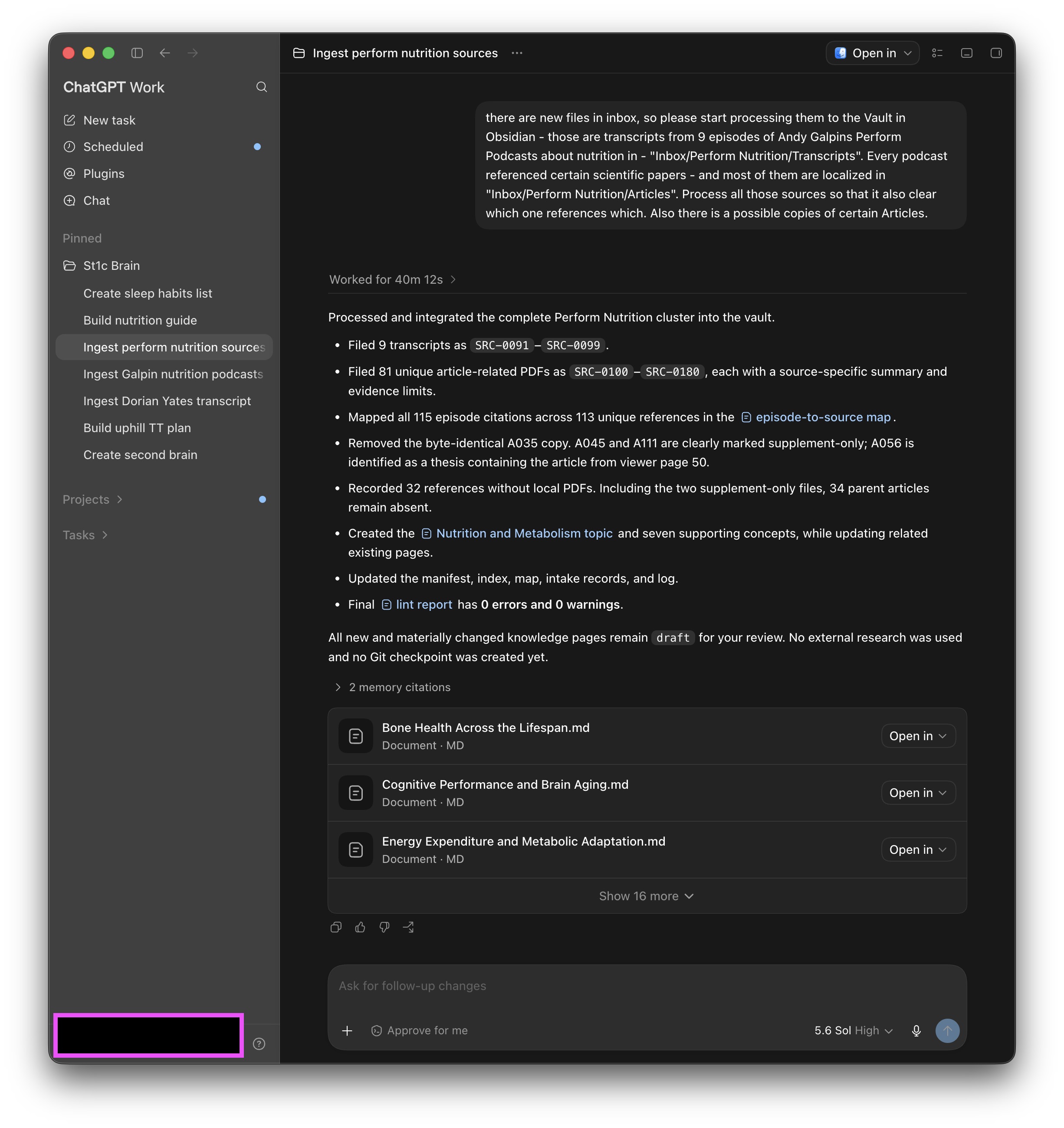
There are new files in inbox, so please start processing them to the Vault in Obsidian - those are transcripts from 9 episodes of Andy Galpins Perform Podcasts about nutrition in - "Inbox/Perform Nutrition/Transcripts". Every podcast referenced certain scientific papers - and most of them are localized in "Inbox/Perform Nutrition/Articles". Process all those sources so that it also clear which one references which. Also there is a possible copies of certain Articles.
That final sentence about duplicates turned out to matter. The ingest did not just move files. It calculated hashes, removed a byte-identical copy, separated full papers from supplements, assigned stable source IDs and built an episode-to-source map.
The processed nutrition cluster contained nine transcripts and 81 locally filed article-related PDFs. Across the episodes, the agent mapped 115 citations to 113 unique references and recorded the papers it could not obtain locally instead of pretending the collection was complete.
A request to "summarize these files" ends with an answer. Asking the agent to process them into the vault leaves behind a maintained asset that can support later work.
Obsidian made the maintenance visible
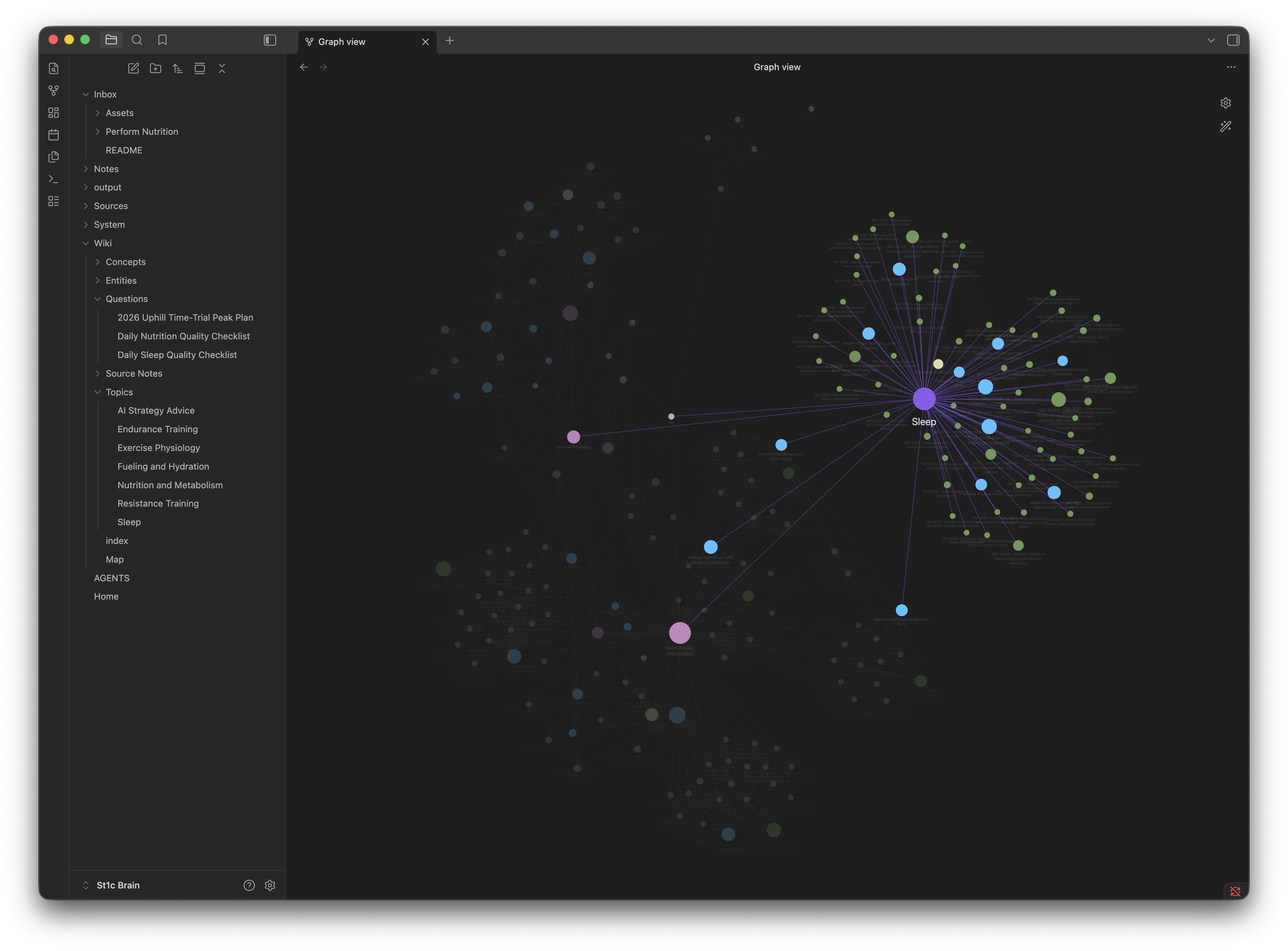
The graph view is not proof that the knowledge is correct, but it is useful for seeing structure. I could immediately see the large sleep cluster, the emerging nutrition and metabolism cluster, shared concepts, isolated sources and questions that deserved their own pages.
Turning the wiki into useful deliverables
With the source work complete, the output prompt could stay simple:
Please, using my vault wiki knowledge, create a nice comprehensive list of things and habits to do every day to improve sleep and sleep quality.
Use the imagegen skill to add nice pictures to the presentation.
The agent created a practical daily routine, checked consequential claims against the source notes, preserved limits and used generated visuals to make the presentation readable. I repeated the process for nutrition.
The finished decks were noticeably better than the general responses I had received from ordinary ChatGPT chats, Deep Research and Pro for the same broad topics. This was an informal comparison, not a benchmark, but the reason was visible in the output. The model was working from a source hierarchy that had already been normalized and cross-linked. It did not need to reconstruct the relationship between every transcript, paper and claim inside one conversation.
The decks also resisted a common failure in health content: converting a narrow study into a universal prescription. The nutrition presentation, for example, distinguishes direct performance evidence from small controlled studies and expert synthesis. It states when an experiment involved a short, specialized athlete population and avoids turning that result into one daily target for everyone.
Where RAG still fits
The llm-wiki pattern solved this particular problem well because the corpus was curated, local and small enough for an agent to maintain directly. It gave me a durable synthesis layer instead of forcing every question to begin with retrieval from raw documents.
RAG still makes sense when a corpus is too large to inspect directly, changes continuously, has complex access permissions or needs low-latency search across many repositories. Retrieval can also become a navigation layer for the wiki itself as it grows. Karpathy's own outline suggests adding local search when an index file stops being enough.
The practical difference is where the durable value lives. In a basic RAG setup, the retrieved chunks and generated answer often disappear after the request. In this system, the maintained Markdown wiki is the asset. Search helps the agent navigate it, but the synthesis, links, contradictions and evidence boundaries persist between questions.
The business use is broader than health podcasts
Sleep and nutrition were convenient test cases because the source material was large, messy and evidence-sensitive. A company corpus could contain very different material:
- meeting minutes and decision logs;
- customer calls, requirements and account context;
- internal procedures and operational exceptions;
- project documents, incidents and postmortems;
- vendor proposals, contracts and delivery evidence;
- product research and competitor material.
The same three boundaries would still matter: protect the original records, maintain a usable synthesis layer, and give the agent explicit rules for ownership, provenance, permissions and review.
For many SMEs, the simplest version can stay on one computer. If more people need access, the vault is still just a folder of files, so it can be shared through the tools the company already uses, such as Google Workspace or similar managed storage with familiar access controls. It is not a perfect collaborative knowledge platform, but it is fast, reliable and often good enough.
This is the kind of controlled automation I find useful. The workflow is clear, the source of truth is protected, the output can be inspected, and the agent's job is bounded by rules rather than hope.
What I took from the experiment
I came away valuing the maintained knowledge base more than any individual answer. It became more useful after each ingest and could produce new deliverables without asking me to rebuild the context from scratch.
That is a more interesting direction for company AI than another generic chatbot over a document folder. The value comes from maintaining the connections: which source supports which claim, where two sources disagree, what is missing, what changed and what can safely be reused.
The model did a lot of work, but the quality came from the system around it: immutable sources, an explicit operating manual, stable identifiers, evidence-aware synthesis, linting and human review. Once those pieces were in place, the presentation prompt could be almost boring. That was the point.