
What keeps bothering me lately is how quickly AI numbers turn into stories. One screenshot appears, one quote gets pulled out of an article, and suddenly people are talking as if they understand the economics of an entire product category. Most of the time they do not. They are just repeating a number and adding a bit of confidence on top.
That is exactly what happened after this Forbes article on Cursor started circulating. The shareable claim was the one everybody latched onto: that a $200 Claude Code Max plan could consume about $5,000 in compute per month. That is a serious number, so of course it spread. The problem is that the interpretation sprinted ahead of the measurement almost immediately.
The weak point is almost always the same. Nobody stops long enough to ask what the number is actually measuring. Is it API-equivalent usage, actual provider cost, reseller economics, or just one slice of a broader subscription? If that part stays fuzzy, the conclusion that follows is usually weaker than it sounds.
My own case points in a very different direction.
I pay $200/month for ChatGPT Pro, and my Codex usage for the period I have been subscribed looks like this:
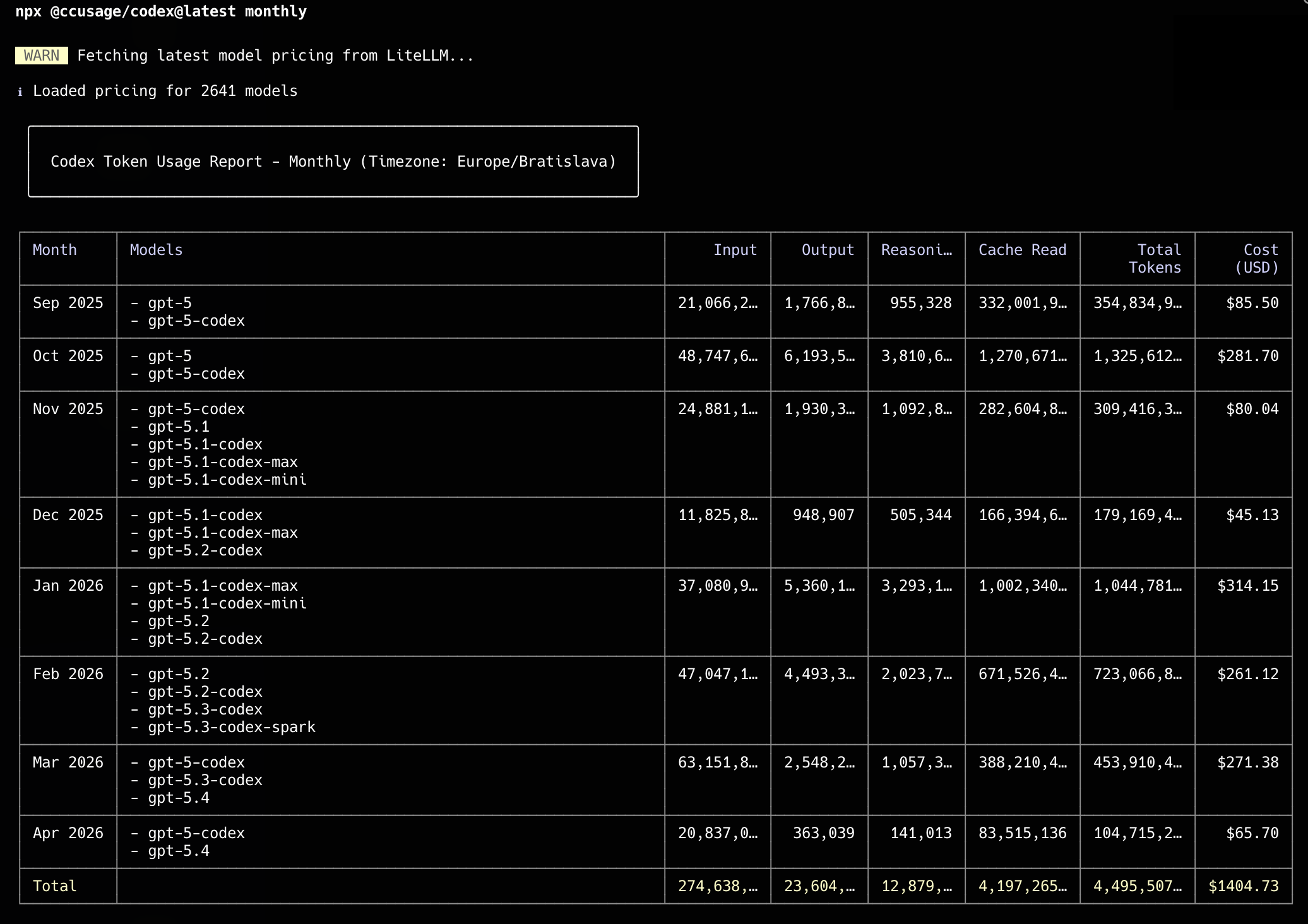
The screenshot was generated with @ccusage/codex, which is a usage analysis tool for OpenAI Codex sessions. There is also a sibling package, ccusage, for Claude Code. I am mentioning that because the tooling matters here too: these reports are useful, but they are still reports built on pricing assumptions and usage exports, not a direct window into provider internals.
That report shows about $1,404.73 in API-priced usage from Codex alone across roughly seven months of use, against about seven monthly Pro payments. I do not read that as proof of some dramatic theory about OpenAI's margins. I read it much more simply: for the way I work, the subscription pays for itself without much effort.
And even that undersells it, because Codex is not the whole product. I use GPT-5.4 Pro heavily for research, I use deep research a lot, and I have found Pulse genuinely useful in day-to-day work. So when I look at the $200/month price, I am not comparing it against one narrow feature. I am comparing it against a workflow that has already become part of how I work across coding, research, and synthesis.
That is why I think people need to be more careful with viral AI takes right now. I am not saying every article is wrong. Usually there is a real number in there somewhere. The problem is that the interpretation outruns the measure, and then the internet does what it always does: it copies the punchline and leaves the nuance behind.
My conclusion is simple. For serious users, AI is still cheap.
Maybe that is not true for everyone. If someone only touches these tools casually, fine, the value equation will look different. But if one surface already clears the subscription fee in API-priced usage, and the rest of the subscription keeps saving time and improving the quality of your work, then $200/month is not a difficult number to defend.
So yes, be skeptical of hype. But be skeptical in both directions. Do not blindly believe the big claim, and do not blindly borrow somebody else's interpretation of the data either. The people getting the most out of these tools are not just the ones using them hard. They are the ones willing to stop, look at the number properly, and decide for themselves what it actually means.